

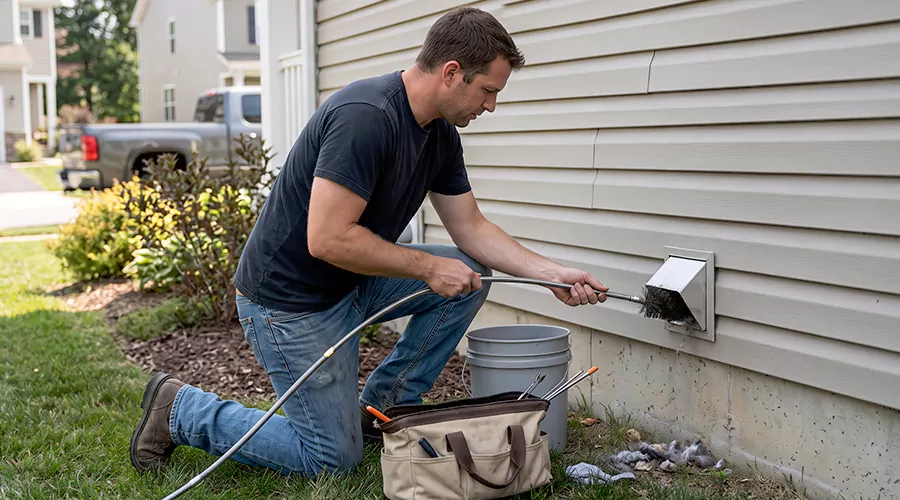
A dirty dryer vent is mainly caused by lint and fabric fibers escaping the dryer's lint filter and collecting inside the exhaust duct. Long duct runs, sharp bends and damaged vent hoses can make this buildup worse by restricting airflow. Over time, accumulated lint may slow drying and increase the risk of overheating or a dryer fire.
A clothes dryer removes moisture from laundry by moving heated air through the drum and exhausting it outdoors. As clothing tumbles, small fibers break away from fabrics and become suspended in the moving air. The lint filter captures much of this material, but some fine particles can still enter the exhaust duct and settle along its surfaces. Professional dryer vent cleaning service removes accumulated lint and helps restore proper airflow through the exhaust system.
Dryer vent buildup is not simply a housekeeping problem. Lint is combustible, and restricted exhaust airflow can cause a dryer to operate at higher temperatures than intended. The U.S. Fire Administration identifies failure to clean as a leading contributing factor in residential dryer fires. Understanding why vents become dirty helps homeowners identify restrictions before they develop into more serious problems.
What Are the Main Causes of a Dirty Dryer Vent?
Dryer vents become dirty when lint accumulates faster than it can be carried outdoors. Normal clothing fibers are the primary source, but the shape and condition of the vent system influence how much material remains inside. Problems become more likely when airflow is restricted by bends or crushed sections.
Lint Escaping the Dryer Filter
The lint filter is designed to capture loose fibers before they reach the dryer's exhaust system. However, even a clean filter does not trap every small particle. Fine lint can continue traveling through the exhaust and collect gradually inside the vent pipe.
This buildup is expected to some degree during normal dryer operation. The amount depends on the clothing being dried and how frequently the appliance is used. Towels and other fabrics that shed substantial lint can contribute more material than some tightly woven garments.
Cleaning the lint screen after every load reduces the amount of debris entering the system. However, it does not replace periodic cleaning of the full exhaust duct. The vent still requires maintenance even when the filter is cleaned consistently.
Clogged or Poorly Maintained Lint Filters
A lint screen covered with thick material restricts airflow through the dryer. The blockage can interfere with the movement of warm, moist air out of the drum. When exhaust airflow decreases, additional lint may collect in other parts of the appliance or ventilation system.
Fabric softener and detergent residues can also accumulate on some lint screens. This coating may be less obvious than a visible layer of fibers. Cleaning the screen according to the manufacturer's instructions helps restore proper airflow through its mesh.
A damaged or missing lint filter creates another concern because more material may enter the exhaust path. Never operate the dryer without its required filter. Replace damaged screens with parts intended for the dryer model rather than attempting to compensate with extra screening inside the vent.
Long Dryer Vent Runs
Long exhaust ducts create more opportunities for lint to settle before reaching the outdoor opening. Air moving through a longer passage experiences resistance, particularly when the installation contains several changes in direction. Excessive length can reduce the airflow available to carry lint outdoors.
The allowable duct length depends on the dryer manufacturer's specifications and the applicable installation requirements. The International Residential Code commonly uses a 35-foot maximum developed length as a default for certain dryer exhaust installations, with deductions for bends. Manufacturer-specific requirements can differ, so this number should not be treated as a universal allowance.
A short, direct vent path generally provides better exhaust performance. However, shortening an existing duct may require changes to the building and should be planned according to the approved venting requirements.
Too Many Sharp Bends
Every bend changes the direction of moving exhaust air and adds resistance. Lint may settle around elbows where the airflow pattern changes or where the duct surface creates a small obstruction. Several closely spaced bends can make a relatively short vent perform poorly.
Sharp bends near the back of the dryer are particularly common when the appliance is pushed too close to the wall. A flexible transition duct may become compressed into a tight curve. This restriction can gradually collect lint and make drying times longer.
A properly installed dryer exhaust should follow the most direct practical route to the outdoors. The duct should also avoid unnecessary sagging or deformation that creates additional resistance.
Crushed or Kinked Vent Hoses
The transition duct connects the dryer to the permanent exhaust duct. This section may become crushed when the appliance is moved backward after cleaning or installation. A kink can reduce the exhaust passage without completely blocking it.
A partially restricted transition duct allows lint to collect near the damaged area. Continued dryer use may add more material until airflow becomes seriously reduced. This can occur even when the permanent exhaust pipe remains relatively clean.
The transition duct should be approved for dryer use and installed without excessive length or compression. If it is severely damaged, replacement is generally preferable to attempting to straighten material that no longer maintains its shape.
Improper Dryer Vent Materials
The material used for the exhaust duct affects how easily lint moves through it. Smooth metal ducts allow air and debris to travel with fewer obstructions than some highly corrugated or flexible alternatives. Plastic and foil-style accordion ducts can trap lint and are more susceptible to crushing.
Building guidance generally calls for smooth metal dryer exhaust ducts, with approved metal transition ducts used where permitted. Vinyl or plastic vent hoses should not be used as substitutes. These materials can create additional fire hazards and may not comply with applicable installation requirements.
The distinction is important because HVAC supply ducts and dryer exhaust ducts have different requirements. A material suitable for circulating room air is not automatically approved for carrying hot, moisture-laden dryer exhaust.
Blocked Outdoor Vent Hoods
The outdoor vent termination allows exhaust air to leave the building and typically includes a flap or damper. Lint can collect around this opening and prevent the cover from moving freely. Debris from outside can also restrict the discharge path.
A vent hood blocked by lint may cause pressure to increase within the exhaust system. Warm, damp air then moves out of the dryer less effectively. The resulting restriction can make lint accumulate more quickly farther inside the duct.
Screens should not be installed across dryer exhaust outlets because they can trap lint. A suitable outdoor termination uses a properly functioning damper while maintaining the required open exhaust path.
Bird Nests and Pest Activity
Birds and small animals may attempt to enter or nest near exterior dryer exhaust openings. Nesting material can create a serious obstruction, especially when the vent flap is damaged or remains open. The blockage may contain more than ordinary lint and can restrict airflow abruptly.
A suspected nest should be approached cautiously because animals may still be present. Protected nesting birds may also be subject to local wildlife rules. The obstruction should be evaluated and removed appropriately rather than forced deeper into the duct.
Repairing the exterior damper can help prevent the same problem from returning. The replacement must remain suitable for dryer exhaust and should not use screening that traps lint.
Why Does Lint Build Up Even When You Clean the Filter?
Cleaning the lint filter removes much of the material released by clothing, but the filter does not capture every airborne fiber. Fine lint can pass through the mesh and move toward the exhaust. Some particles eventually settle on the duct surface, particularly around bends and other restrictions.
Lint accumulation also depends on the overall airflow through the dryer. A filter may appear clean while a crushed transition duct is limiting exhaust movement. In that situation, lint can collect inside the vent because the air is not moving freely enough to carry it outdoors.
Regular filter cleaning and full vent cleaning perform different maintenance functions. The filter needs attention after every load, while the exhaust duct requires periodic inspection and cleaning. Both are necessary for maintaining normal airflow.
Where Does Dryer Vent Lint Usually Collect?
Lint can accumulate anywhere along the dryer exhaust path, but certain locations are more vulnerable to restrictions. Bends and connections may create areas where fibers settle. A problem can also develop at the exterior opening when debris prevents the damper from moving properly.
| Dryer Vent Location | Common Problem | Why Buildup Occurs |
|---|---|---|
| Lint filter housing | Loose fibers and residue | Particles collect near the screen |
| Dryer exhaust outlet | Lint near the connection | Debris exits the appliance |
| Flexible transition duct | Kinks and lint deposits | Corrugations and restricted passage |
| Duct elbows | Accumulated fibers | Air changes direction |
| Long horizontal run | Settled lint | Reduced airflow and long travel distance |
| Vertical duct run | Lint trapped around bends | Resistance and difficult access |
| Outdoor vent hood | Lint or nesting material | Debris collects near discharge opening |
The location of buildup influences how the vent can be cleaned. An accessible transition duct may be relatively simple to inspect. A long vertical passage terminating on the roof can require specialized equipment and safe access.
Cleaning only the lint screen does not remove material trapped in the exhaust duct. Similarly, clearing the exterior flap may improve airflow while leaving debris deeper in the system. The complete path should be considered when investigating a persistent restriction.
What Are the Warning Signs of a Dirty Dryer Vent?
A dirty dryer vent often causes drying performance to decline as lint restricts the exhaust passage. The changes may be gradual, making them easy to overlook. However, a dryer that suddenly becomes unusually hot or produces a burning smell requires prompt attention.
Common warning signs include:
- Clothes need more time than usual to dry.
- A normal load requires two drying cycles.
- The dryer cabinet becomes unusually hot.
- Laundry feels excessively hot after the cycle.
- Warm, humid air accumulates in the laundry room.
- The outdoor vent produces noticeably weak exhaust airflow.
- Lint collects around the exterior hood.
- The outdoor vent flap does not open normally.
- A musty or unusual odor develops near the exhaust.
- The transition hose appears crushed or damaged.
- Visible lint accumulates behind the dryer.
- A burning smell occurs while the appliance operates.
These symptoms are reasons to inspect the dryer rather than proof that lint is the only problem. A failed heating component or other appliance malfunction can also affect drying. However, an obstructed exhaust should be ruled out before the dryer continues operating normally.
If there is a burning smell, smoke, or evidence of overheating, stop using the dryer immediately. If smoke or fire is present, evacuate and contact emergency services. Do not continue running the appliance to determine whether the smell disappears.
Can a Dirty Dryer Vent Cause a Fire?
A dirty dryer vent can increase fire risk because lint is combustible and restricted airflow can contribute to overheating. When hot, moisture-laden air cannot escape efficiently, the dryer may operate under abnormal conditions. Accumulated lint in the vent or internal appliance areas can become part of a fire hazard.
According to U.S. Fire Administration reporting for residential dryer fires from 2018 through 2020, failure to clean was the leading factor contributing to ignition, accounting for approximately 31% of incidents. This does not mean that every dirty vent will catch fire. It does show why routine cleaning is an important part of dryer safety.
The risk is influenced by several conditions, including the amount of lint and the venting materials used. Crushed hoses and obstructed outdoor outlets can make a buildup more serious. Proper vent installation and regular cleaning help reduce avoidable hazards.
A dryer should not be left running when the home is unoccupied or while everyone is asleep. The appliance also needs the correct electrical connection and sufficient clearance from combustible storage. These precautions work alongside proper vent maintenance rather than replacing it.
Can a Dirty Dryer Vent Increase Energy Bills?
A clogged dryer vent can increase energy consumption because restricted airflow may extend the time needed to dry clothing. Moist air must leave the appliance for the laundry to dry effectively. When that airflow slows, the dryer may continue operating without achieving the expected results.
A load that once dried in one cycle may require an additional cycle. The extra running time uses more electricity or gas, depending on the appliance. However, the exact additional expense depends on the dryer and the severity of the restriction.
Cleaning the vent may restore normal drying performance when lint buildup was the main problem. If drying remains slow afterward, the issue may involve the appliance or laundry load rather than the exhaust duct. Proper diagnosis prevents unnecessary repeated cleaning.
How Does Dryer Vent Design Affect Lint Buildup?
Dryer vent design influences how effectively warm air and lint travel outdoors. Short and smooth metal passages generally provide less resistance than long ducts containing multiple elbows. Correct vent routing also reduces areas where moisture or lint can remain trapped.
| Vent Design | Effect on Airflow | Likely Maintenance Concern |
|---|---|---|
| Short, straight metal duct | Lower resistance | Normal periodic lint cleaning |
| Long duct with multiple bends | Greater resistance | Faster buildup at restrictions |
| Crushed transition hose | Reduced exhaust passage | Localized lint accumulation |
| Ribbed plastic hose | Poor material and airflow characteristics | Lint buildup and fire hazard |
| Smooth rigid metal duct | Better exhaust passage | Inspect and clean periodically |
| Exterior screen | Traps exiting lint | Blocked outdoor outlet |
| Damaged outdoor flap | Allows unwanted entry | Debris or pest activity |
The correct duct length and configuration depend on the dryer manufacturer's installation instructions and applicable building code. Some installations require additional design considerations for long runs. Adding a booster fan without confirming that it is approved for the system is not an appropriate response to an unknown blockage.
How Can You Check Whether Your Dryer Vent Is Dirty?
A basic inspection can identify obvious lint buildup and restrictions without dismantling the appliance. Start with the lint filter and the accessible outdoor exhaust hood. These areas provide useful clues about airflow through the system.
First, remove and clean the lint screen according to the manufacturer's instructions. Next, examine the transition duct behind the appliance if it can be viewed without unsafe movement. Look for visible crushing or excessive bending.
During a normal dryer cycle, check the outdoor exhaust from a safe position. The flap should open and warm, moist air should leave the vent. Weak airflow may indicate a restriction, although it does not identify the exact location.
The following observations are useful:
- Whether drying time has increased over recent weeks.
- Whether the lint filter is cleaned after every load.
- Whether the transition duct is crushed or disconnected.
- Whether the outdoor damper opens freely.
- Whether lint is visible around the exterior outlet.
- Whether the exhaust route contains several sharp bends.
- Whether the vent has been cleaned within the past year.
Do not remove a gas supply connection or climb onto a roof to inspect a vent. If reaching the duct requires moving a gas dryer beyond the available connection slack, a qualified technician should handle the work.
How Often Should You Clean a Dryer Vent?
The National Fire Protection Association recommends cleaning lint from the dryer vent pipe approximately once a year, or sooner when drying performance suggests a restriction. The lint screen needs much more frequent attention and should be cleaned before or after every load. Higher laundry volumes may justify additional exhaust inspections.
| Dryer Component | Suggested Maintenance |
|---|---|
| Lint filter | Before or after every load |
| Lint filter housing | Inspect and clean as needed |
| Transition duct behind dryer | Check periodically for damage and buildup |
| Full exhaust duct | Approximately once a year or sooner when needed |
| Outdoor vent flap | Check periodically for free movement |
| Interior dryer components | Service according to manufacturer recommendations |
A household that operates several loads every day may accumulate lint more quickly than one that uses the dryer occasionally. Vent length and the condition of the duct also influence maintenance needs. The schedule should become more frequent when unusual drying times or reduced outdoor airflow are observed.
Cleaning frequency alone does not guarantee a safe installation. A crushed or improperly vented duct may require repair or replacement regardless of when it was last cleaned.
What Should You Avoid When Dealing With a Dirty Dryer Vent?
Some cleaning practices can damage the duct or create new obstructions. A common mistake is pushing lint farther into the exhaust rather than collecting it. Others involve using unsuitable duct materials or introducing extra restrictions near the outlet.
Avoid these mistakes:
- Operating the dryer without its lint filter.
- Continuing to use a dryer that overheats or produces a burning smell.
- Replacing an approved metal duct with a plastic vent hose.
- Installing mesh screening across the outdoor exhaust outlet.
- Using screws that protrude into the exhaust and catch lint.
- Crushing the transition duct when moving the appliance.
- Venting a conventional dryer into an attic or crawlspace.
- Ignoring repeated slow drying after cleaning the lint screen.
- Disconnecting gas lines without appropriate training.
- Using aggressive cleaning tools that could tear a flexible transition duct.
Dryer exhaust ducts should not be treated like ordinary HVAC supply ducts. The dryer carries hot, moisture-laden exhaust and lint, so its installation and cleaning requirements are different. Materials and repair methods should be suitable for dryer exhaust service.
When Should You Call a Dryer Vent Cleaning Professional?
Professional cleaning is appropriate when the vent contains a heavy blockage or follows a long concealed route that cannot be reached safely. Roof terminations and vertical ducts can be especially difficult to inspect. A technician can use suitable tools to remove lint and evaluate the condition of the exhaust passage.
Professional evaluation is also appropriate when an outdoor flap remains closed despite cleaning or when the dryer continues overheating. These symptoms may indicate a damaged duct or an appliance problem. Repeatedly operating the dryer under restricted conditions is not an appropriate troubleshooting method.
Gas dryer connections deserve particular caution. If the appliance must be moved far enough to disturb the gas supply, have a qualified professional handle the work. The gas connection should remain intact and properly checked whenever it has been disconnected or serviced.
How Can You Prevent Dryer Vents From Getting Dirty Too Quickly?
Some lint accumulation is unavoidable because clothing sheds fibers during normal drying. However, regular maintenance and proper vent installation can reduce excessive buildup. Keeping the exhaust path unrestricted helps the dryer carry lint and moisture outdoors.
Clean the Lint Filter Every Load
Remove accumulated lint from the screen before or after every drying cycle. Inspect the screen periodically for detergent or fabric softener residue that may restrict the mesh. If washing is recommended by the manufacturer, allow the screen to dry completely before reinstalling it.
Keep the Transition Duct Unrestricted
Check that the connection behind the dryer is not crushed or sharply bent. Move the appliance carefully after cleaning so the transition duct retains its intended shape. Use only transition duct material approved for the appliance and applicable installation requirements.
Maintain the Outdoor Vent
Check that the exterior flap opens freely when the dryer operates. Remove accessible lint from around the outlet while the dryer is off. Do not install a screen across the opening because it can create another place for lint to collect.
Follow a Regular Cleaning Schedule
Plan a full exhaust cleaning approximately once a year, or sooner when symptoms indicate a blockage. Keep a record of the last cleaning date and any repairs to the vent. A recurring restriction despite frequent cleaning may suggest that the vent layout or duct material needs correction.
Conclusion
A dirty dryer vent develops mainly because lint escapes the filter and accumulates inside the exhaust system. Long runs and damaged hoses can make the problem worse by restricting airflow. Buildup may increase drying times and contribute to fire risk. Regular filter cleaning and periodic exhaust maintenance help keep the appliance operating safely. This week, inspect the lint screen and outdoor vent flap for signs of a developing restriction.